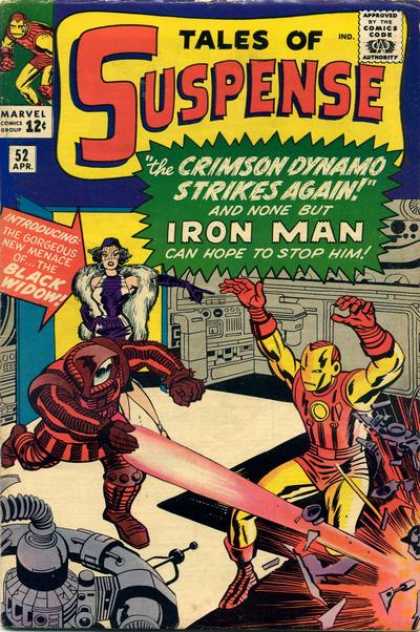
"The Crimson Dynamo Strikes Again!"
Plot: Stan Lee
Script: Don Rico (as "N. Korok")
Art: Don Heck
Synopsis: Last we saw Anton Vanko, the brilliant Russian scientist had defected to America and become an employee of Tony Stark. Now he works tirelessly developing the new "laser light", which if it could be perfected would be a powerful new weapon for Stark's defense contracts.
Vanko believes he can test the last using his Crimson Dynamo armour, but the weapon is still unstable and Stark has to rescue him at the last moment, trying to convince the Russian that he does not need to sacrifice his life to redeem himself.
Meanwhile, in Soviet Russia, Khruschev wants Vanko so dead, that he calls in his top spies to "eliminate" him -- Boris, a hulking brute, and Natasha, a beautiful femme fatale otherwise known as the Black Widow. Yes, two Russian spies named Boris and Natasha -- get it? Get it??
Anyways, the plan is for the Black Widow to seduce Tony Stark while Boris finds and kills Vanko. Thus, they are dropped off in New York by a secret Soviet spy sub, and show up at Stark's munitions plant in Flushing claiming to be science teachers from Soviet Ukraine (so, still should be pretty suspicious and probably not allowed anywhere near a munitions plant in America in 1964) -- so of course Stark agrees to give them a full tour of the plant.
Natasha manages to distract Stark with her sultry Russian hotness in order to give Boris a chance to find Vanko. Boris paralyses Vanko with a ray gun Vanko himself had designed, then kidnaps him and steals the Crimson Dynamo armour -- Boris seeks to use the armor to destroy Stark and Iron Man both and thus become a national hero back in the USSR.
He starts using the armor to blow up the plant, which causes Stark and Natasha to come rushing back from the swanky nightclub they'd apparently gone off to when the plot wasn't looking.
In the smoke and confusion of the firefighters and security men, Stark changes to Iron Man and discovers Boris in the Crimson Dynamo armour, causing him to believe Vanko has betrayed him. Boris zaps Iron Man with an electrical charge which shorts out his systems, and takes him back to the sub where he lies prisoner along with Vanko.
Luckily, the Russkies were foolish enough to leave Iron Man locked in a room with a power outlet, and thus one extension cord and charging period later he's back to full power, rescuing Vanko, smashing up the sub, and heading back to Flushing.
Back at the factory, Iron Man confronts the Crimson Dynamo and the two do battle. However, the Crimson Dynamo has the upper hand on Iron Man, and so in that moment Anton Vanko grabs the laser prototype, firing it at the Crimson Dynamo, destroying both of them in the unstable surge of energy that follows, giving his life to the ideals of freedom.
In the excitement of the explosion, the Black Widow escapes justice, but with her true identity revealed to the authorities she is a fugitive in America, and with the failure of her mission she can never return to the Soviet Union, and thus she must wander the country in constant fear of discovery.
~~~~
My Thoughts: Amazing what small beginnings big things can have, isn't it? In this issue, we are introduced to Natasha Romanov, aka the Black Widow. Today we all know Black Widow as a badass member of the Avengers with flaming red hair played Scarlet Johansson in a skintight catsuit on the big movie screens, but in this initial story she's an dark auburn haired femme fatale cliché with a name that's essentially an early 60s pop culture reference joke. She has very little role in the story beyond distracting Stark, and yet Stan still gives her a cool, mysterious personality and an interesting ending that highlights the tragic lonliness of the life of a spy.
Even though she's not the focus of the story (which is the return of the Crimson Dynamo and the death of Anton Vanko), she manages to steal the show.
The Art: Good stuff from Don Heck this month. I don't really get Black Widow's fur boa or her veiled hat but I guess this was early 60s visual shorthand for "femme fatale" the same way a black catsuit became visual shorthand for "badass spy". Good action panels in this issue, but my favourite element of Heck's art is the human one, the expressions on his characters. Most affecting of all is the look on Tony's face when his friend sacrifices his life for what he believes in. Heck's art really sells the melodrama of the moment.
The Story: While the meat of the plot is the two Russian spies and the stealing of the armour and the action and the fights, the meat of the drama is Anton Vanko. Convinced somewhat conveniently to defect to America in the closing panels of ToS #46, Vanko is now trying to redeem himself for past sins and develop weapons for the American military complex. But it's also clear he has a bit of a death wish, given that he wants to dangerously testfire a deadly weapon at himself (while wearing his armour) even when Tony explains that it is totally not necessary.
It's an interesting philosophical difference between Tony and his friend -- Stark believes one can redeem themself and become a hero without the need for sacrifice and loss, while Vanko clearly believes the only path to redemption is in death for the sake of others. Even though Vanko has defected to the capitalist side, his philosophical values remain rooted in communist thinking.
What I'm saying is that with all these elements in play and with only thirteen pages to play with, Stan delivers a very compelling tale. In this, he is helped along by former Timely/Atlas/Marvel writer Don Rico, operating under the pseudonym of "N. Korok" because by the early 60s Rico's comics career was largely over and he had become a successful paperback writer, likely writing the script for this and next month's issue as a favour to Stan.
Stark Science: Light amplification by stimulated emission of radiation, or "laser" technology, had been under serious development since 1957 in both the US and the USSR, in conjuction with other radiation emission technologies such as masers and rasers. In the US, a legal battle between Gordon Gould and Bell Labs had been raging since 1960 over intellectual ownership of the technology. The first functional laser was developed at Hughes Research Laboratories in California in 1960 (Howard Hughes of course being one of the primary inspirations for Tony Stark).
Most lasers are dangerous because fired into human eyes their strong light can be blinding, but what Vanko is working on here is a high powered laser to burn through solid objects, a very 1960s sci-fi kind of laser such as in the movie "Goldfinger", which has persisted as a pop culture idea to this day. The first laser was capable of burning through a Gillette rasor blade, and class 4 industrial lasers today can burn skin. However, truely effective laser weapons are still beyond the capability of modern technology largely due to the immense power such weapons would require.
Boris fires a "jet paralyser" gun at Vanko, which sprays "magnetic artificial fibers" which wrap around the target and immobilizes them. Needless to say, this is all comic book scientific mumbo jumbo, a lot of impressive sounding words put together to say a gun that fires a net at a dude.
Iron Man's batteries must be hella efficient to recharge to full power in such a short amount of time from the power of a Soviet submarine -- also, he must have a voltage adapter somewhere in that suit of his to transform the 220V power used in Europe to his American 120V system.
Notes and Trivia: First appearance of the Black Widow, first and last appearance of the second Crimson Dynamo, death of Anton Vanko.
This issue was adapted into issue #3 of Enter the Mandarin.
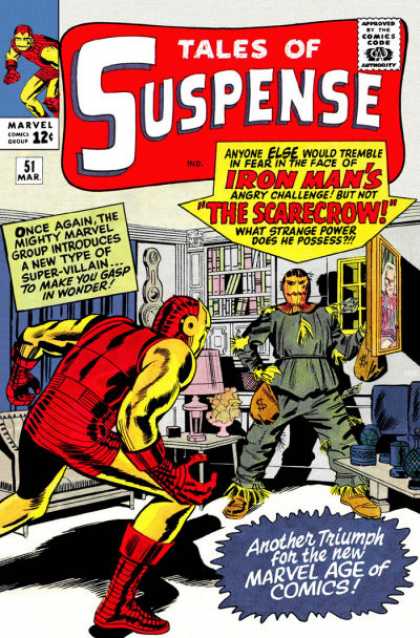
"The Sinister Scarecrow"
Writer: Stan Lee
Artist: Don Heck
Synopsis: Iron Man is pursuing a thief through a vaudeville theatre when he's assisted by a contortionist called the Uncanny Umberto who figures helping Iron Man collar a crook would be goo publicity. Iron Man makes a remark that he's glad Umberto is on the side of the law with abilities like his, which of course immediately inspires Umberto to abandon his career as a vaudeville contortionist and become a criminal! Which was probably a good move since I can't imagine how he was making a living as a vaudeville performer in the 1960s.
Of course he can't become a criminal without a costume, and so he decides to be a scarecrow after seeing a scarecrow costume in the window of a costume store. Luckily it fits since he's as "flexible as a scarecrow anyway", but can you imagine if the first costume he saw was Sexy Nurse or something?
Then he steals some trained crows from one of the other acts (don't worry, he was retiring) and figures that since they're familiar to him they'll listen to him and act like accomplices like he was in a Disney cartoon or something. Then he decides his first target will be the New York penthouse apartment of Tony Stark (he'd been renting his mansion to the Avengers for a while by now) because Stark is always out with girls so he's an easy target.
Seriously this guy is the most slapdash crook I've ever seen.
Meanwhile a model named Veronica Vogue shows up at Stark Industries to pick up Tony but Pepper lies to her and tells her Tony is out of town. With no one to go out with, Tony has Happy drive him to the apartment, where they find the Scarecrow trying to rob Stark's wallsafe.
Happy starts to fight the Scarecrow, but is outmatched. However it gives Stark the opportunity to change into Iron Man, but Scarecrow stages a diversion and escapes, sending Iron Man on a wild chase by making him follow his trained crows while he slips away.
Scarecrow manages to steal some new weapons plans Stark is designing for the Defense Department, which he plans to ransom from Stark.
Stark decides to meet Scarecrow at the pier with the money alone (so to best transform into Iron Man), against Happy's objections. However when the Scarecrow shows up he merely steals Stark's briefcase full of money and jumps on a boat headed for Cuba to sell the plans to the Reds as well!
Scarecrow rendezvous with a Cuban gunboat to turn over the plans, but Iron Man shows up, grabs the plans, knocks the Scarecrow and the Cubans into the water and sinks their boat. Scarecrow has his crows tow him on a line to Cuba, an escape that would only take about 40 hours to make, and yet Iron Man lets him go because his transistors are almost out of power. Uh-huh.
Back in the States, Tony needs to do something with two tickets to a Broadway show he was going to attend with Veronica, and Pepper is hoping he'll ask her but instead he gives them to her and Happy so they can go together! Meanwhile, Scarecrow plots revenge on the Cuban shore.
~~~~
My Thoughts: In the previous issue, Iron Man battled one of his greatest foes for the first time. In this issue, he fights a Batman villain.
Well, to be fair, while the Scarecrow is best known today as a member of Batman's Rogues Gallery, that character hadn't appeared in a comic since 1943, and wouldn't appear again until 1967, so using the persona again wouldn't have confused any kids of te time, it just demonstrates Stan Lee scraping the bottom of the barrel for villain ideas. I mean, the comic tries it's best to justify that a guy wearing burlap and straw who can do gymnastics really well is a worthy adversary for a genius in powered armour, but it really never takes.
The Art: Good stuff from Don Heck this issue, although at times the backgrounds get a little vague and stylized and Tony's penthouse suite seems to be made up of a lot of non-descript Kirbyesque machinery for no reason. Pepper's looking more and more glamourous with each appearance.
The Story: The Scarecrow is a lousy villain. His motivation to become a supercriminal seems to be simply because we need one this issue, and the whole adventure feels very perfunctory. Stealing Stark plans to sell to Cubans is a good idea and rings topical to when this comic was published, but it's also very similar to recent issues and Stan could've used a character like the Chameleon who's already established as a Soviet spy. On the whole the issue isn't bad, so much as it is ho-hum and utterly forgettable between last issue (first Mandarin) and next issue (first Black Widow).
Stark Science: We learn that the Mk II armour can stand up to small arms fire but would have a problem with machine guns, and that it's flight power is limited by the transistorized batteries such that flying to Cuba from New York is out of the question.
Honestly the most scientifically dubious thing in this issue is the Scarecrow's trained birds. Crows are very intelligent birds, but they are also stubborn and independant and are not easily trained at all. So the fact that our villain has taken crows someone else has trained to perform vaudeville tricks and is using them to commit crimes and steal precise things and do a whole bunch of exact stuff seemingly via telepathy from him (like flying him to Cuba), is kind've ridiculous.
Notes and Trivia: The first appearance of the Marvel Comics version of the Scarecrow, who will go on to menace other Marvel heroes but never will get that revenge on Iron Man he's contemplating.
While fighting Iron Man, the Scarecrow mentions that it's widely known Stark employs the Golden Avenger as a bodyguard. While past villains have noticed that Iron Man is always around to protect Stark's stuff, I believe this is the first time the idea of him being explicitly employed as Stark's bodyguard has been mentioned.
This issue's story would be adapted into issues #2 and #3 of Enter the Mandarin.
Classic Marvel comics overhype themselves so much on their covers that it can sometimes be hard to tell which issues actually are important milestones and which issues are utter trash.
Well, hold on to your hats, merry Marvelites, because this truly is "another mighty milestone in this, the Marvel Age of Comics!"
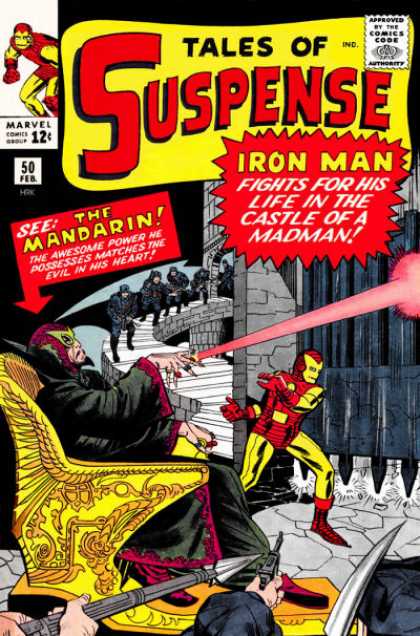
"The Hands of the Mandarin!"
Writer: Stan Lee
Artist: Don Heck
Synopsis: Our story opens with a pageload of Stan Lee hyperbole building up the bold new threat of the Mandarin, the most feared man in all of Red China and in no way a rip-off of an outdated racial stereotype character.
In his castle in Red China, he is visited by soldiers in the Red Chinese army, who request that he share his atomic science secrets with them so that the communist government can possess the bomb, as well as share with them the secret of his power rings -- ten rings he wears on each finger that seem to grant him magical abilities.
The Mandarin refuses, he serves no man and shall one day rule the world for himself, and so the Red Chinese soldiers flee in terror from his castle.
Meanwhile, back in America, the CIA have requested that Iron Man fly a dangerous reconaissance spy mission into Red China to gather information about the Mandarin, whom the CIA perceive as a threat but do not know much about.
Back at his factory in Flushing, Tony tells "Bill", the head of the factory's employee's association, that he'll be unable to attend the employee's dinner that night, but that he's appointed Happy Hogan to go in his place. Bill grumbles about how the boss can't be bothered to associate with the hired hands, and Happy decks him one for the comment. Tony gives Happy a stern dressing down for this impulsive action, and apologizes to Bill -- at which point Pepper Potts becomes very annoyed that she's been standing there this whole time and no one's noticed her make-over! With a new hair-do, colour, and make-up, she's gone from a Peggy Olson to a Joan Holloway! Tony admits he didn't even notice her, while Happy remarks he liked her better the old way.
Flying over mainland China, a US spy jet drops Iron Man into enemy territory. Approaching the Mandarin's castle, he's jumped by the warlord's private guard, but of course they are no match for Iron Man!
Seeing Iron Man's approach on one of his monitors, the Mandarin draws him into the castle with a magnetic beam, depositing Iron Man in an empty room where... the walls are closing in!
Flying out through an air vent, Iron Man finds himself in the control room of the Mandarin, where an epic battle of abilities begin, as the two exchange a flurry of beams, rays, and waves until finally the Mandarin locks Iron Man with a paralysis ray!
Back in the States, Pepper is so desperate for a date to the employee's dinner... she actually asks Happy!! The chauffeur figures that without the boss there to "cramp my style" he can "really operate!"
His transistor power weakened by the effort to escape the Mandarin's paralysis ray, Iron Man finds himself at the mercy of the Chinese sorceror, who reveals that he had weakened the hero to the point where he could indulge in his favourite pasttime... karate! (An odd choice for a Chinese aristocrat, wouldn't kung fu be more appropriate? Oh right, it's the early 60s, Stan Lee wouldn't have heard of kung fu).
The Mandarin proves to be remarkably strong, capable of breaking iron bars with a karate chop, making him a formidable opponent for Iron Man, who resorts to using a wrist-installed calculator to calculate the ideal angles to block the Mandarin's blow -- the pain of hitting Iron Man's armour at the wrong angle causes the Mandarin to pass out, and so Iron Man beats a hasty escape, meeting up with his pick-up plane back to the states.
Somehow this all happens within a space of a day, because Tony Stark shows up in his tux for that employee's dinner after all, charming the girls -- while all the men have been charmed by Pepper! Happy is afraid that Tony will steal Pepper from him, while Pepper is afraid that Tony will never ask her out if he thinks she's dating Pepper! Oh, the soap opera!
But back in Red China, the "Oriental menace" of the Mandarin plots his next move, his revenge against Iron Man!!
~~~~
My Thoughts: So here it is, the debut of The Mandarin -- Iron Man's archnemesis! His Lex Luthor, his Joker, his Moriarty, his Red Skull, his Green Goblin, his Fu Manchu --
Right, so here's the thing about the Mandarin. He's a really, really great villain. Even in this introductory story, you can see the elements that make him the best antagonist for Iron Man. Stark's science versus Mandarin's "magic", capitalism versus communism, freedom versus dictatorship, etc. Not only that, but of all the villains Iron Man's met so far, Mandarin has the most personality, the most pizzazz, the most threat -- but then, he's borrowing a lot of that characterization from Fu Manchu.
Okay, so he's a good character in an exciting story, but the fact of the matter is that he's a rip-off, and the character he's a rip-off of is a notorious "Yellow Peril" racist caricature stereotype. So does that make the Mandarin a racist caricature stereotype? Well, yes it does. But does that make him a bad character?
I'd argue no, no more than Fu Manchu is a bad character. Fu Manchu was created by Sax Rohmer as a menacing "supervillain", in many ways the first of his kind, playing on the fears of the "Yellow Peril" common in the early 20th century. Patterning his villain after the fears of his readers makes him no different than any other effective author, while his creation proved immensely popular -- spawning radio shows, comic strips and books, film serials, and features. Fu Manchu was also immensely influential on the pulp magazine writers and comic writers of the time, defining in many ways the character of the "criminal mastermind" and thus the supervillain - no Sax Rohmer, no Walter Gibson, no Ian Fleming, etc.
Well, Stan Lee was a teenager at the height of Fu Manchu's popularity, and was a big fan of Sax Rohmer, and had apparently always wanted to create an "inscrutable" Asian villain as an homage. So in that way, I can't say that the Mandarin was coming from an evil place in terms of racism. Maybe a lazy place in that he's not so much "inspired" by Fu Manchu as he's a direct copy, but I don't think it's an evil one.
We can't change the place of casual racism that characters like Fu Manchu, and thus the Mandarin, came from -- what matters is how these characters are used today. The Mandarin became Iron Man's premiere villain, and writers like John Byrne and Joe Casey have used the character fantastically in recent years, maintaining his Chinese heritage instead of whitewashing it, while not devolving into racial caricature.
The Art: It feels good to have Don Heck back on art duties. As much as I think Steve Ditko could've made an ideal Iron Man artist philosophically, Heck really has a great sense of Tony Stark and his world -- Heck inking Ditko might be ideal, but I would rather keep Heck on Iron Man so I could get all those great Ditko Spider-Man issues. Heck draws The Mandarin as a standard Fu Manchu type, except with the addition of a bizarre mask, and of course his trademark ten rings. Heck also updates Pepper's appearance this issue -- she's a redhead officially now and looking quite glamourous.
The Chinese characters in the story are drawn in a somewhat caricatured way, but it doesn't feel malevolent or negatively stereotyped in nature.
The Story: It's clear that this story was merely meant to introduce the Mandarin, with Lee intending to bring the character back as a regular basis. He knew he'd hit on an archenemy for Iron Man, and so this story is mostly about establishing the Mandarin as a major threat -- we don't get an origin for the character, merely a lot of scenes and dialogue establishing how powerful he is. We don't know the source of his power, whether magic or technology, or what the deal with his ten rings are -- the rings being the main thing distinguishing Mandarin from his inspiration.
What's interesting is that he doesn't even have a specific evil plan -- he's a presence, pre-existing, already powerful. Iron Man wanders in to find out who this Mandarin character is and his victory is simply in getting out alive. It's a good story, but it's also very simplistic, intended as it is merely as an intro, and it's only thirteen pages -- supported by some standard Marvel Comics soap opera love triangle stuff. It's an overture to a series of Mandarin appearances coming up that will climax with Tales of Suspense #55.
These issues would be retold in Joe Casey's Enter the Mandarin mini-series, an excellent story that makes the implicit themes in the battle of Mandarin and Iron Man explicit in very well written dialogue. I love those issues, and I thought about reviewing them alongside the originals here before deciding to stick to publication order -- however for fans of the Mandarin who wish to see his first encounters with Stark told in a more Modern Age style, it's a great book to pick up.
Stark Science: Because Stan doesn't give us an origin or explanation for the Mandarin's power, it's hard to comment on his ten rings, which at this point could be magic, science, or "science so advanced it appears as magic."
The communists want the Mandarin's atomic research, which implies he's a scientist or technological expert of some kind. Red China's nuclear program had begun research in 1959 after Soviet Russia cut off their support -- they would succeed in detonating their first atom bomb on October 16, 1964.
We discover the Mark II armour's chest mounted "ultra-beam" is capable of dispelling any ray of "less than cosmic intensity", which makes it a pretty powerful defense.
Without commenting on the comic book technological powers of Iron Man and Mandarin, the most implausible element of the whole story is the spyplane that gets Iron Man to the Mandarin's castle. While we aren't given much context on the location of the Mandarin's castle, most of China is in fact just outside the range of the CIA's Lockheed U2 spyplane which would have been used for such an operation, if it had left from and returned to Idlewild Airport as the text suggests.
But let's assume the U2 makes it, that the Mandarin's Castle is in range (when it most likely isn't) -- Tony is at the Pentagon when the story starts, flies 250 miles to his plant in Flushing (no way of knowing how long that takes), then takes the U2 from Idlewild to China - a journey which even at maximum speed would take the plane 15 hours, then he battles the Mandarin and gets on another plane for another 15 hour U2 flight back to NYC -- all in time to arrive at the employee dinner that was going on the very evening of the day he left!! Even with international time zones and day barriers and such, that seems highly impossible!
Notes and Trivia: First appearance of The Mandarin. First appearance of "post-makeover" Pepper Potts. This issue takes place after The Avengers #3 and #4, in which The Hulk left the team and became a menace alongside the Sub-Mariner, and the Avengers discovered and revived the frozen form of Captain America, who then became the new team leader.
This issue's story was adapted into issues #1 and #2 of Enter the Mandarin.
Well, we're 11 issues in and we've got our first cross-over! The novelty will wear off by the time we hit the 90s, let me assure you.
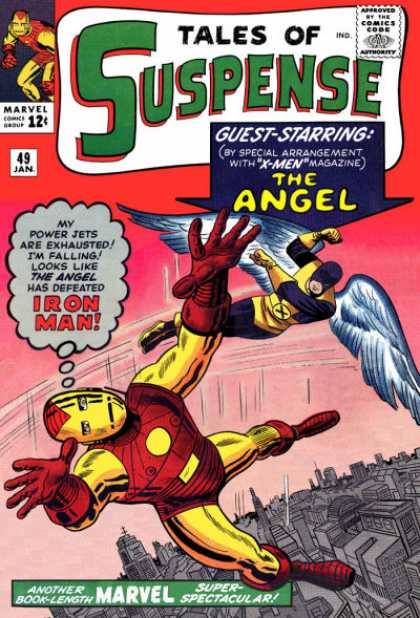
"The Angel"
Writer: Stan Lee
Pencils: Steve Ditko
Inks: Paul Reinman
Synopsis: The Angel, a member of the fledgeling X-Men, decides to fly over the Stark Industries factory in Flushing as "shortcut" to Professor Xavier's mansion in Westchester.
However, at that moment Iron Man is guarding an atomic explosion test and when he sees Angel he tries to warn him off from the blast zone. How the hell does Stark get the permits for these things?
Anyways, if a scientist trying to warn a teen away from an atomic blast test sounds familiar to you, then you can guess what happens next. Iron Man is unsuccessful in warning the Angel and the bomb goes off -- luckily the Mk II Iron Man armour can withstand the force of the blast and radiation but Angel is hit with the full force of the radioactivity.
And instead of killing him, it turns him evil. Yes, you read that right, he turns evil.
Now, to be fair, personality changes are a possible side effect of radiation to the brain, but Iron Man's reaction that this is just what he feared would happen is so completely ridiculous.
Anyways, the now-evil Angel flies to the X-Mansion where he announces to the rest of the X-Men (Cyclops, Marvel Girl, Iceman and Beast) that he is quitting the X-Men to go join the "evil mutants".
The X-Men try to stop him, but fail, because as Chris Sims has taught us, the X-Men are terrible at being superheroes. With this being a major emergency, Professor Xavier sends a call out to the Avengers to assist them in taking down Angel before he joins the "evil mutants". However, none of the team gets the signal except... Iron Man!
Meanwhile Angel has been flying around New York City dropping dynamite on people thinking that this will get the evil mutants' attention and let them know he's on their side, but they all think it's a trap and stay home and do not appear in this comic.
Instead, Iron Man shows up and the two have a battle in the skies for four pages, narrating to themselves every action they do in the best Silver Age tradition, that ends up overtaxing Iron Man's transistor batteries and so he begins to plummet to his death -- which causes the inner good in Angel to come out just in time for him to snap out f being evil and rescue Iron Man.
At this point it is revealed that Iron Man planned to run out of batteries (uh-huh, sure Tony) and force Angel to save him because he knew that this would cause Angel to snap back to his old self as well as demonstrate to the NYPD watching the situation that Angel wasn't really evil.
Angel goes back to the X-Men and Professor X promises to do Iron Man a favour in return some day.
~~~~
My Thoughts: It's hard for us to understand the impact that the shared Marvel universe had in the early 1960s. Today corporate comics are almost defined by their incestuous interconnectedness, opague continuity and untangleable storylines. But in the early 60s the idea that characters from one comic existed in the same world as characters from another was radical.
Now, to be fair DC had pioneered the concept with Justice Society of America, World's Finest, Brave and the Bold, and finally Justice League of America, but the DC universe was still very nascent and disconnected -- sure Batman and Superman hooked up in some books, but their solo series where still very much contained.
Stan Lee changed everything when he started having his major characters start appearing in each other's books on a regular basis, weaving a web of storytelling that drew tighter and tighter until to readers of the time it really did seem like the Fantastic Four, Ant-Man, the Hulk, Thor, Spider-Man, Iron Man, Dr. Strange and all the rest really did all live a few minutes drive away from each other in a bizarrely crowded and event-filled New York City.
You can see how unusual this was by the blurb at the start of this story which states that the X-Men and the Avengers appear by permission of the owners of their respective magazines, a bizarre notice considering they're all owned by Martin Goodman.
However, the biggest hurdle for any cross-over story, even today, is justifying just why these characters are together in the same book. Sometimes it seems like a natural extension of the story, building the universe these characters live in, other times it feels like shameless cross-promotion.
Hmmm... which one is this?
The Art: Paul Reinman inks over Steve Ditko this ish, which makes sense because Reinman was Kirby's inker on the original X-Men and so the idea was probably to retain the look of the characters in the cross-over. But Reinman really isn't suited to ink Ditko - the story looks rough, it lacks polish and subtlety, Reinman's lines are thick and really drown Ditko's pencils. It's not a pretty issue to look at.
The Story: Oh, man, Stan. I'm willing to give a lot of leeway for Silver Age ridiculousness, but "Angel shows up and turns evil because of radiation and fights Iron Man" is NOT one of your best ideas, nor does the execution make up for it. This whole comic is just so useless -- we learn nothing about the characters, there's no meaningful interaction between Iron Man and the Angel other than chases and fights, and Angel turns evil just as arbitrarily as he turns good again.
Consider how one of the central themes of the X-Men is protecting a world that fears and hates them, and how early on it was in the book's history (only two issues had come out), so it would be easy to justify that people wouldn't trust the X-Men and would perhaps lump them in with all the "evil mutants" given that we're building up towards the height of anti-mutant hysteria in X-Men #15. It would be interesting to see if Tony would give in to that prejudice, if he'd assume all mutants are bad. How could we compare and contrast Tony and Angel -- who is also a rich white guy named Warren Worthington III, who like Tony has a physical condition (heart defect, wings) that he must hide from the public but is also connected to his secret identity. But nope! None of that. To be fair, with the X-Men being as new as they were at this point I can concede that they aren't being characterized very deeply -- but that doesn't change the fact that Angel has always been the least interesting of the original X-Men, except for that other time that science turned him evil.
Usually the way hero cross-overs go is that there's a contrived reason for the heroes to fight, then they realize they are on the same side, and team up. In this issue, all we get is the contrivance.
Stark Science: Stark Industries is setting off an experimental nuclear device in Flushing Meadows??? How the hell did they manage that??
A nuclear bomb small enough ("refined" is the word Stan uses) that it could be set off in a controlled explosion amidst the most populous city in America and only radioactively affect people in the very nearby vacinity would have to have a yield as small as, say, 3 kilograms. Which is, of course, waaaaaaay smaller than the minimum theoretical yield of 10 tons for a fission weapon. Then again, maybe that's what Stark was testing.
Even assuming a nuclear weapon that small (which, even if you could do it, what would be the point? 3 kilograms is a small explosion), it's amazing that this comic isn't about Iron Man and Angel slowly dying of radiation poisoning. Iron has to be 5.2mm thick to withstand 100 keV of radiation, which is about how much an x-ray at the doctor's tends to be -- even an nuclear explosion below the minimum yield limit has more keV of radiation than that, especially absorbed at the meager distance our heroes were at, meaning Tony's armor would have to be significantly thicker than the "wafer-thin" it was described as being last issue.
As for the Angel, who takes all of the radiation with none of the protection, well, granted, the trope of "radiation gives you superpowers instead of cancer" was fantastically, incredibly, amazingly common in early Marvel Comics, but usually it manifested in the form of mutations and physical transformations. The idea that radioactivity makes you evil and that this is such a common thing that Stark was expecting it, and then that the effect of the radioactivity that would cause such a change in brain chemistry can be shaken off a few hours later through the strength of inner morality?
Yeah, this isn't a great issue of Iron Man for science.
Then again, the story sees the debut of Iron Man's "magnetic repellers" -- devices in his boots and gloves that he uses to slow his descent and push off from the ground a few times in this story in tandem with his "air jets". These devices will slowly evolve into "repulsor rays", the most significant of Iron Man's gadgets.
Because the focus of this blog is Iron Man, not the X-Men, I'm not even gonna try on the science of mutations in the Marvel Universe.
Notes and Trivia: Iron Man meets the X-Men, who now owe him a favour.
Based on the Jack Kirby cover art, we can already tell this is an issue to be excited about. Red-and-gold, baby!
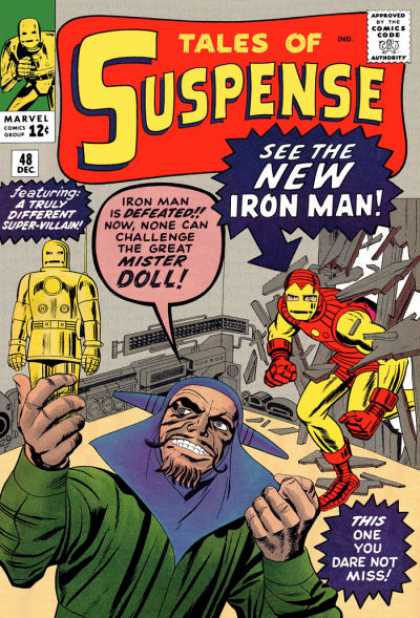
"The Mysterious Mr. Doll!"
Writer: Stan Lee
Pencils: Steve Ditko
Inks: Dick Ayers
Synopsis: A Mr. Carter unexpectedly reneges on a deal to supply Stark Industries with steel. Tony heads over to Carter's residence to find out what's going on.
On arrival he spots a costumed criminal entering Carter's house, and so changes into Iron Man to confront him. The costumed individual's name is "Mr. Doll" and he has been torturing Carter with sympathetic magic, harming a fetish in Carter's image and causing him pain until he has finally agreed to sign over all of his money, estate and business over to Mr. Doll.
Iron Man moves to attack Mr. Doll, but the villain is able to dextrously alter the features of his clay doll to resemble Iron Man, and thus apply pressure to cause the Golden Avenger great pain. Iron Man ends up having to retreat, the strain of fighting Mr. Doll's attack was too much for his heart and he must rush home to recharge. Carter signs his forture over to Mr. Doll.
Stark is only able to just barely reach his private office in time to plug in, and spends an entire day unconscious on the floor, recharging. When he awakes, he realizes that he's been having to recharge more and more, that he's becoming increasingly vulnerable as Iron Man because the suit is so heavy, bulky and inefficient that it's taking so much charge to run the suit that his heart is in danger of failing on him. (Apparently replacing all the iron in the suit with aluminium last issue wasn't enough to help!)
And so Tony resolves to build a brand new model of the suit that will be lighter, faster and more efficient, so that he can defeat Mr. Doll before the strain on his heart grows too great.
Meanwhile, the police implore Mr. Carter to swear out a complaint against Mr. Doll, as Carter is the third millionaire to be threatened into signing over his forture but the law cannot move against him -- and Carter won't sign a complaint out of fear against Doll. Who, at that moment, is planning his next victim - millionaire Tony Stark!
But Tony has completed the Mark II Iron Man armor, it's brand new features introduced to us in a THREE-PAGE, twenty-two panel suiting up sequence:
Of course, even though the new armour is undoubtably sweet, I'm not sure how it's supposed to defeat a dude with vodoo magic.
Luckily it turns out that Stark has been asked by the police to act as bait so they can catch Mr. Doll, as he's the next logical target. Stark agrees, but needs to shake the tail he's been given so he can change into Iron Man. So he does the rational thing and takes Pepper on a date in a sealed room where the guard agrees to leave the two of them alone because no one could get in or out. Instead of realizing this is very creepy behaviour for her employer, Pepper is overjoyed her crush has finally noticed her and jumps on Stark to start making out like she's got no time to spare!
Of course, Tony's actually planned this so he can access a secret door in the room to get out and change to Iron Man, but thanks Pepper for her energetic "performance" that will "convince" the guard. Ew.
Mr. Doll shows up at Stark's factory, which he declares will make an excellent headquarters (for what? What is he after, anyway?) before promptly using his doll to inflict pain upon Iron Man. He reveals to Iron Man that he learned this magic in Africa from a witch doctor and he will now inflict pain on Stark so that he will sign the factory over to him!
Iron Man must now not betray any sign that he feels the pain that is being inflicted upon him or else give away his secret identity. Luckily Doll orders Iron Man to retrieve Stark and bring him there on pain of death, giving Iron Man a chance to escape.
He still feels the intense magical pain, so once in his workshop he disconnects the power from his heart so that his nerves will deaden and not feel the pain long enough for him to complete a weapon to use against Mr. Doll. He manages to do it within the four minutes the brain can survive without oxygenated blood, and flies off to face Mr. Doll.
Doll changes his talisman to resemble Iron Man and then prepares to drop it, the force of which might kill him, but Iron Man fires a small force beam at the clay figurine which actually changes the doll's appearance to that of Mr. Doll himself! The doll drops, and so does Mr. Doll.
Doll is arrested, and Tony Stark reappears, where Happy Hogan reminds him that the totally forgot about Pepper Potts left waiting in the storage room. She's so mad she won't speak to either of them!
~~~~
My Thoughts: As I mentioned in the previous review I am a huge fan of Steve Ditko, and one of his greatest strengths is costume design. Spider-Man is one of the all-time classic designs, up there with Superman and Batman, and I think part of the reason The Question has lasted so long is his visual distinctiveness. So here we have the debut of the classic red-and-gold look for Iron Man, designed by Ditko, which will last in variations of some form or another up until this very day. It's hard to really grasp how HUGE this is. Stan always knew that Iron Man would be constantly upgrading his armour, but this is a MAJOR change in look, and in 1963 superheroes didn't channge their costumes every six issues like they do now. This really was a NEW Iron Man. Too bad it happens in such an otherwise lame story.
The Art: Great stuff from Steve Ditko this month, with of course an absolute classic new look for our hero debuted. And clearly Marvel knew this was a huge improvement since they let Ditko have three pages out of an eighteen page story to introduce it. On the other hand, Ditko's being inked by standard Kirby collaborator Dick Ayers, and I'm not sure if it's a great pairing. In the previous issue Don Heck had been inking and this helped keep characters like Tony, Pepper, and Happy "on-model" as it were with their appearances as Heck had created them. Ayers' alters Ditko far less, and as a result the figure work is classic "quirky" Ditko, which renders characters like Pepper as "less attractive" than normal. On the (third?) hand, Ditko's talent for expressive faces really serves him well, especially with Tony's pained eyes seen through the eye-holes of his mask.
The Story: Of course, none of this should hide the fact that this is really a fifteen-page story about a boring one-note villain that is only "book-length" because it got three extra pages to introduce the "New" Iron Man. Now, it's true that putting science-based Tony Stark up against a villain who uses magic is a good idea because Tony can't just science his way out of things (except when he does), but Mr. Doll is so freakin' dumb. I mean, yes, he was originally supposed to be named "Mr. Pain" until the Comics Code Authority nixed that idea. And a more menacing name like that may have helped, but at the end of the day he's still just a crazy guy in a stupid hat extorting money out of rich people using vodoo dolls because... ?? What's the motivation? What's the scheme?
Also, and maybe this is just me, but when Iron Man had to rebuild his entire suit to fight against the Melter last issue, maybe that would've been the time to intro the New Iron Man, instead of against a magic-based foe for whom the change in armour really affects nothing.
Stark Science: Mr. Doll's powers work on the premise of sympathetic magic, and he might have learned it in West Africa among the religions of voodoo and juju, where it could have something to do with the "nkisi" figures. In other words, this is magic, not science.
Stark's new armour has a ton of new features and gadgets. It's made of ductile iron, and consists of boots and gloves that then expand magnetically to form the greaves and sleaves of the outfit. There are back-up transistor batteries in all the individual pieces, but it still plugs-in for recharging if all the back-ups run out. The new helmet slides into place and allows Stark's expression to show to "strike fear into his enemies". Right, because you weren't similar enough to Batman, Stark.
The force beam that reshapes the clay figurine is left so vague that we can't really question the science behind it, but let's just say a remote beam that can reshape clay into exact forms is fairly implausible.
Notes and Trivia: Debut of the Iron Man Armour MARK II, otherwise known as the classic red-and-gold look. This issue is set after Iron Man's appearance in The Avengers #2, wherein he grants the Earth's Mightiest Super-Heroes permission to use his mansion in the Upper East Side of Manhattan as their base of operations. When he next appears in Avengers #3 he'll be wearing his new red-and-gold armour.
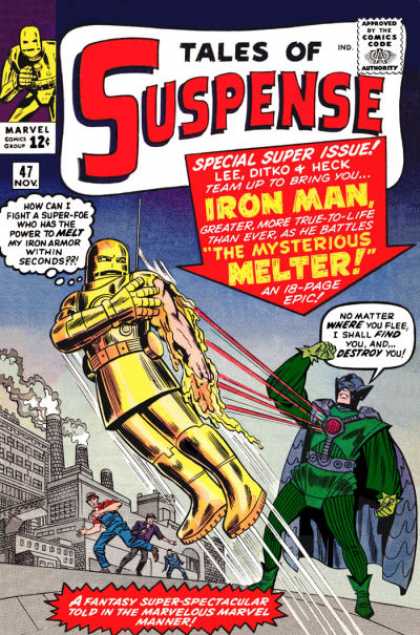
"Iron Man Battles the Melter!"
Writer: Stan Lee
Pencils: Steve Ditko
Inks: Don Heck
Synopsis: In recent army demonstrations, Stark tanks have been failing, falling apart. Looking into the problem personally, Tony Stark is attacked by a costumed saboteur called The Melter, whose melting ray has been causing the sabotage.
In a flashback, it is revealed that the Melter is in actuality Bruno Horgan, a former competitor of Stark's.
Horgan's military technology used inferior materials and ultimately his defense contracts were taken away and given to Stark. As he was closing down his factories and plants, Horgan accidentally discovered a ray that melts iron instantly (but doesn't seem to affect other materials - it's not just an intense heat ray, but seems to affect iron atoms directly).
Horgan figures that the power to melt iron at will makes him invinicibly powerful and so creates a costume and mask so he can "plunder at will". As The Melter, he begins his attacks on Stark's factories so to get back at him and the US army both.
The Melter leaves Stark alive for some reason, and so when Stark awakes he returns to his office and changes into Iron Man in order to fight him. The Melter takes out the generators for Stark's plant, and when Iron Man attempts to intervene the Melter melts his armour's arm, so the Golden Avenger is forced to make a hasty retreat -- however he smashes the factory's steam pipe on the way out, forcing the Melter to retreat as well.
Changed back to Stark, he inspects the damage and orders his men to work around the clock at triple pay to repair the damage. Meanwhile, Tony puts all his other commitments on hold so he can work on a way to defeat the Melter. Tony knows that if the beam were to melt his mask, or his chest plate, during battle it would be disastrous. But he's not helpless, he's "got the greatest weapon in the world... a human brain!"
However, even Tony Stark can't ignore a summons to Washington, where he learns that the brass believe Tony has made up the Melter as an excuse for why his production has fallen behind. And if production is not straightened out, he'll lose his cushy government contracts!
Stark is called back to Flushing for an emergency at the plant. The Melter is attacking again, threatening Pepper and Happy and the lives of everyone else at the plant.
However this time when he attacks Iron Man... nothing happens! The Melter flees but Iron Man knows the plant's layout far better and confronts him at every turn. The terrified Melter melts the floor beneath his feet and flees into the water mains beneath the plant.
Without knowing if the Melter is alive or dead, Tony changes out of his suit -- now made of "tough extruded aluminum"! Soon he's back to giving orders to his employee - and Happy wonders if things are better or worse when everything's back to "normal"!
~~~~
My Thoughts: The third of three great stories in a row, this story is helped out immensely by it's longer, 18-page length, by the face that Stan is actually scripting as well as plotting, and by introducing a villain who, like the Crimson Dynamo, is unique and feels specific to Iron Man in both motivation and method. This is really the first Iron Man story where I can feel the personalities of the characters coming through, and you really appreciate the addition of Pepper and Happy to the cast. Also, like the last two stories, I really enjoy that we see how the villain threatens both Iron Man and Tony Stark, giving him ample motivation to defeat him. This story feels like the culmination of the promise of the previous two -- it's the first really good Iron Man story.
The Art: Pencils here are being handled by one of my all-time favourite comics artists - Steve Ditko! Ditko was one of Stan's main collaborators in the early days of Marvel, an amazingly idiosyncratic artist with a very quirky style all his own, very unique from that of Jack Kirby's. To this day, "Kirby or Ditko?" is a question much akin to "Beatles or Rolling Stones?" or "Pepsi or Coke?" At the time of this issue, Ditko was eight issues into a 38 issue run on Amazing Spider-Man, a character he co-created with Lee, and was also illustrated the adventures of Dr. Strange in Strange Tales. Eventually Ditko would have a falling out with Lee and leave Marvel to create characters such as Blue Beetle, The Question, The Creeper, and Hawk and Dove over at DC. About midway through the 1960s Ditko discovered the works of Ayn Rand and became an ardent Objectivist, a belief system that began to heavily influence his art.
I'm not sure if Ditko had discovered Objectivism by 1963, but it doesn't appear so as it's values hadn't begun influencing his storytelling yet. Either way, I love Ditko's work in this issue and I wish he had become a regular artist for Iron Man -- he might've stayed at Marvel longer, as Tony Stark is almost an ideal Objectivist hero, basically Hank Rearden in an iron suit!
Ditko's style is often described as "quirky", his faces have great expressive qualities which reveal a lot of character and his panels are often very dynamic and effective while working solely on variations of a regular six-panel grid layout. He's being inked by Don Heck, presumably to lend a feeling of continuity to the feature similar to Heck's inking of Jack Kirby - but while Heck keeps the cast on model and recognizable, his inking doesn't temper Ditko's essential flavour as much as it tempered Kirby's -- it's still very clearly Ditko.
The Story: By presenting a simply one-villain tale in 18 pages Stan is able to expand on his scenarios more and give more characterization. This is the first Iron Man script Stan's written himself, and as such it feels much more "alive", with that classic trademark Marvel characterization. Happy, Pepper and Tony grow from one-dimensional characters to, well, two-dimensional characters. All their essential qualities were already there, but Stan lets them shine. Iron Man develops a sense of humour, in the style of the standard Marvel "mock the villain" gags. The Melter, like Jack Frost and Crimson Dynamo, feels like the kind of villain Iron Man should be fighting - a technologically based villain with a mission to destroy Stark, which brings in Iron Man to defend.
My absolute favourite element of the whole story however has to be that Stark explicitly is depicted as outthinking the villain -- using his mind, described as his greatest weapon, to conquer his foe. That is absolutely what Iron Man stories should be about and what Tony Stark represents as a hero: the triumph of reason and rational values. And Stan even remembers to let the Melter get away so he can return as a villain in the future! Excellent.
Stark Science: The Melter's melting ray is just one of those piece of hogwash comic book science we have to accept - somehow it can heat up iron particles to 1538 Celsius (2800 Fahrenheit) without affecting anything else -- for example it doesn't light Stark's arm on fire when it melts his armour. It also clearly affects alloys of iron in addition to pure iron, as we know that the armour is an iron alloy that is (somehow) non-magnetic (which is ridiculous). So yeah, the ray only affects iron and nothing else, which is ridiculous but we just gotta buy it.
Which is why Tony's able to beat it by simply building his armour out of something other than iron, in this case extruded aluminium. Which is kind've a terrible replacement choice -- aluminium is very malleable much weaker than iron. There's a reason we make pop cans out of aluminium and not tanks. But I guess it got the job done. Although, does this make him Aluminum Man now?
Notes and Trivia: First Iron Man story written solely by Stan Lee, Stark debuts the MARK I MOD 3 armour out of aluminium, first Iron Man armour not actually made of iron.